
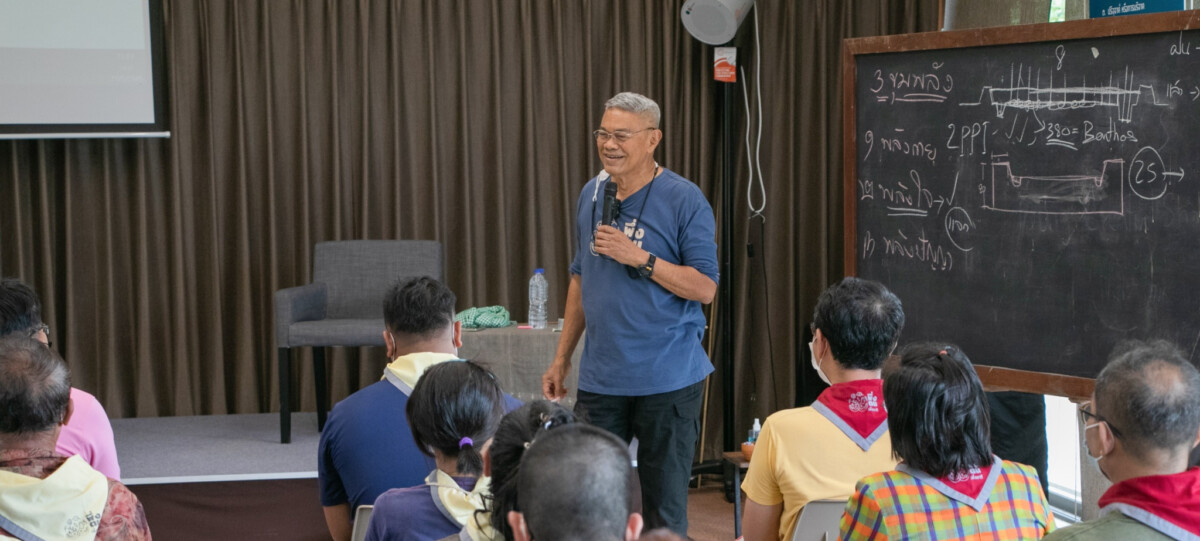
New Theory Agriculture
During the reign of His Majesty King Rama IX, he undertook numerous Royal Initiative projects, which aimed to integrate traditional wisdom with modern knowledge through research and experimentation to address real-life problems in various areas. This experimentation, coupled with action to address the problem, was conducted multiple times in different regions, focusing mostly on solving agricultural issues and improving the livelihoods of farmers, who constituted a significant portion of the population. Areas of focus included land and water management, agricultural knowledge dissemination, and conservation of forests and the environment. The successful outcomes of these problem-solving efforts led to the development of numerous new theories and approaches to address and sustain the livelihoods of Thai people.
Khok Nong Na
Model
The “Khok Nong Na Model” is a new theory that focuses on designing spaces and water management strategies to address the growing challenges of frequent and severe droughts and floods caused by global climate change. It begins with the excavation of ponds and the development of a water canal system known as the “Sai Kai Canal” to effectively store water. Soil excavated from these ponds is utilized to construct hillocks for residential and livestock purposes. By planting forests comprising “3 Forests, 4 Benefits” and doing organic rice farming, people can totally take care of themselves with enough food, water, and shelter. Plus, the trees give us shade, which is awesome for the environment.
At PANNAR Center, the area has been designed according to “Khok Nong Na Model”, and the following operations have been carried out
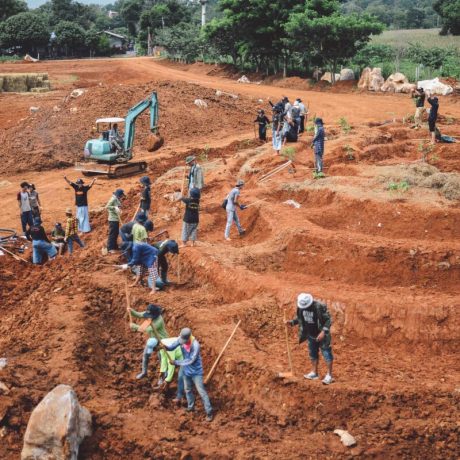
Creating hillocks
Creating hillocks, planting forests of “3 Forests, 4 Benefits” , turning them into 5-tier forest to facilitate soil water retention systems. Additionally, excavating Sai Kai canals on the hillocks to store and distribute water. Moreover, raising free-range or naturally-fed egg-laying chickens and ducks.
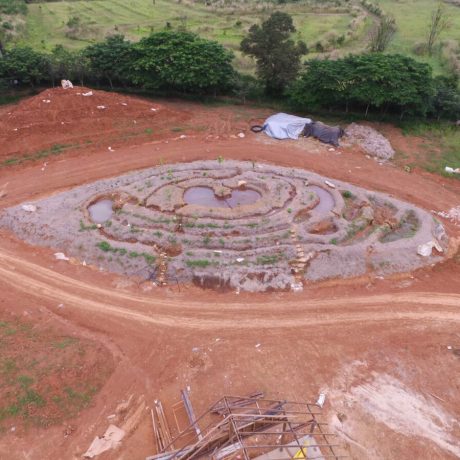
Excavating ponds and Sai Kai canals
Excavating ponds and Sai Kai canals to store water, with the ponds designed in a Free Form style to mimic natural water sources. Creating inner pond edges as resting places for aquatic animals and for planting aquatic plants for consumption.
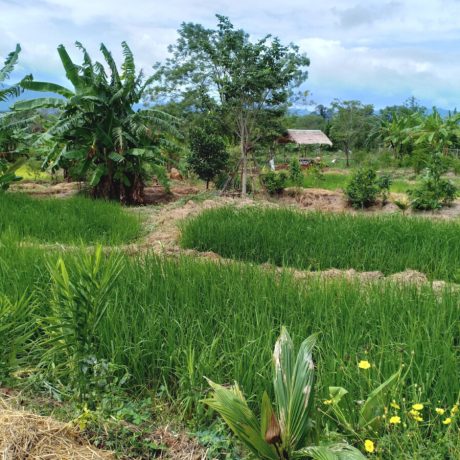
Growing organic rice farming
Growing organic rice farming by raising the bunds of the rice paddies high and wide to retain water. Digging trenches around the inner edges of the paddies to provide habitat for aquatic animals during the period of water release for rice harvesting. Additionally, planting vegetables and fruit trees on the bunds.
Ecological Agriculture
Ecological agriculture is a guiding principle centered on agricultural practices that prioritize the preservation of natural resources and seek to maintain a harmonious balance within ecosystems for long-term sustainability. This entails steering clear of chemical inputs like fertilizers, pesticides, and herbicides, abstaining from the burning of crop residues, and safeguarding the soil’s protective layer. Moreover, ecological agriculture emphasizes the utilization of beneficial microorganisms to enhance soil health and fertility.
Activities conducted at the PANNAR Center include
"Sai Kai Canal"
Mulching the soil and digging "Sai Kai Canal" to retain moisture.
Producing wood vinegar
solution to prevent and control plant pests.
Planting leguminous crops
Making herbal fermented solution for preventing and eliminating fungi and bacteria such as bitter herb and astringent herb
Making soil for planting
seedlings using a mixture of coconut coir, fertile soil, cow dung, and rice husk charcoal, instead of peat moss.
Making fermented herb solution for insect repellent such as sour herb, spicy herb, volatile aroma herb, and intoxicating taste herb, as alternatives to chemical insecticides.
Planting leguminous crops
to increase nitrogen levels in the soil.
Producing organic compost
both dry compost (composted manure) and liquid compost (fermented banana stems), which help to condition the soil and replenish nutrients naturally instead of using chemical fertilizers.
3
Forests,
4
Benefits
According to His Majesty King Rama IX’s royal speech, there is an emphasis on instilling a sense of responsibility and care among communities through “3 forests, 4 benefits”. It underscores the direct benefits that forests offer to communities, including the provision of wood for various uses, materials for constructing homes, and fruit-bearing trees for consumption. Additionally, it highlights the importance of forests in conserving soil and water sources. This directive offers solutions for all relevant sectors and encourages community involvement in leveraging forest resources for their benefit, thereby ensuring sustainable conservation of forest resources.
PANNAR Center has planted forests according to the guidelines of His Majesty King Rama IX, focusing on “3 forests, 4 benefits”.
Fast-growing trees
for utility purposes include Lead tree (Kratin Narong and Kratin Thepha), and bamboos.
Construction timber
comprises hardwood or economically valuable timber, such as as Teak, Ironwood, Siamese Rosewood, Burmese Rosewood, Black Rosewood, Siamese Sal, Burmese Sal, White Meranti.
Perennial fruits and herbs
such as Jackfruit, Wild Mango, Rambutan, Longan, Indian Gooseberry, Chebulic Myrobalan, and Beleric Myrobalan.
9-steps
Progressive
Development
PANNAR Center adheres to a 9-step progressive development model aimed at achieving sustainable self-sufficiency. Starting with hands-on activities guided by principles until successful and self-reliant in all 4 basic needs for survival or able to depend on oneself, then expanding towards an advanced sufficient economy.
The 9-step ladder towards sustainable self-sufficiency comprises:
New Theory Agriculture
9-step Progressive Development
Step 1. Sufficiency in Food
Having enough food to eat by growing rice, crops, vegetables, and fruits without the need to spend money to buy them.
Steps 2., 3., and 4. Sufficiency in usage
Sufficiency in shelter, and Sufficiency in shade: These are attained concurrently through the cultivation of "3 Forests, 4 Benefits“. These are achieved simultaneously by cultivating the "3 Forests, 4 Benefits" initiative. Forest cultivation guarantees an abundant supply of wood for diverse purposes, offers timber for constructing shelters, fosters medicinal herb cultivation, and preserves environmental equilibrium.
Steps 5. and 6. Merit making and Alms giving
Once we have fulfilled the four basic needs, we proceed to engage in acts of merit making and alms giving. These steps involve giving and sharing, as well as cultivating a mindset detached from greed.
Step 7. Preservation
This involves ensuring food security to prevent scarcity, preserving seeds for the next season, and processing food to preserve for future consumption or during times of crisis.
Step 8. Selling
Selling with integrity, driven by a sense of generosity, and a desire to share the good things we cultivate ourselves.
Step 9. Networking
Establishing a nationwide network to expand the success in line with the sufficiency economy principles, aiming to transform the way of life of communities and society. This aims to address environmental crises, natural disasters, pandemics, food shortages, and social conflicts.